Trans Mountain is proposing a Mainline Optimization Project to enhance the performance and capacity of its pipeline system between Strathcona County, Alberta and Burnaby, British Columbia. The proposed work includes:
- Construction of approximately 30 kilometers of new 36-inch diameter pipeline adjacent or near the existing pipeline system north of Kamloops, BC between Darfield and McLure.
- Eleven new pump stations on the existing pipeline system in Alberta and British Columbia and additional pump capacity and modifications within the existing fencelines of facilities in Strathcona County, AB and Hope, Abbotsford and Burnaby, BC.
- Associated electrical power transmission and distribution system upgrades.
Value for Canada
Optimizing the pipeline system could strengthen Trans Mountain’s contribution to Canada’s energy economy by:
- Expanding access to international markets to strengthen Canada’s energy competitiveness.
- Improving the efficiency and value of oil transport.
- Increasing revenues for all levels of government, delivering greater economic benefits for Canadians.
- Supporting long-term financial stability through enhanced system performance.
- Creating procurement and employment opportunities during construction.
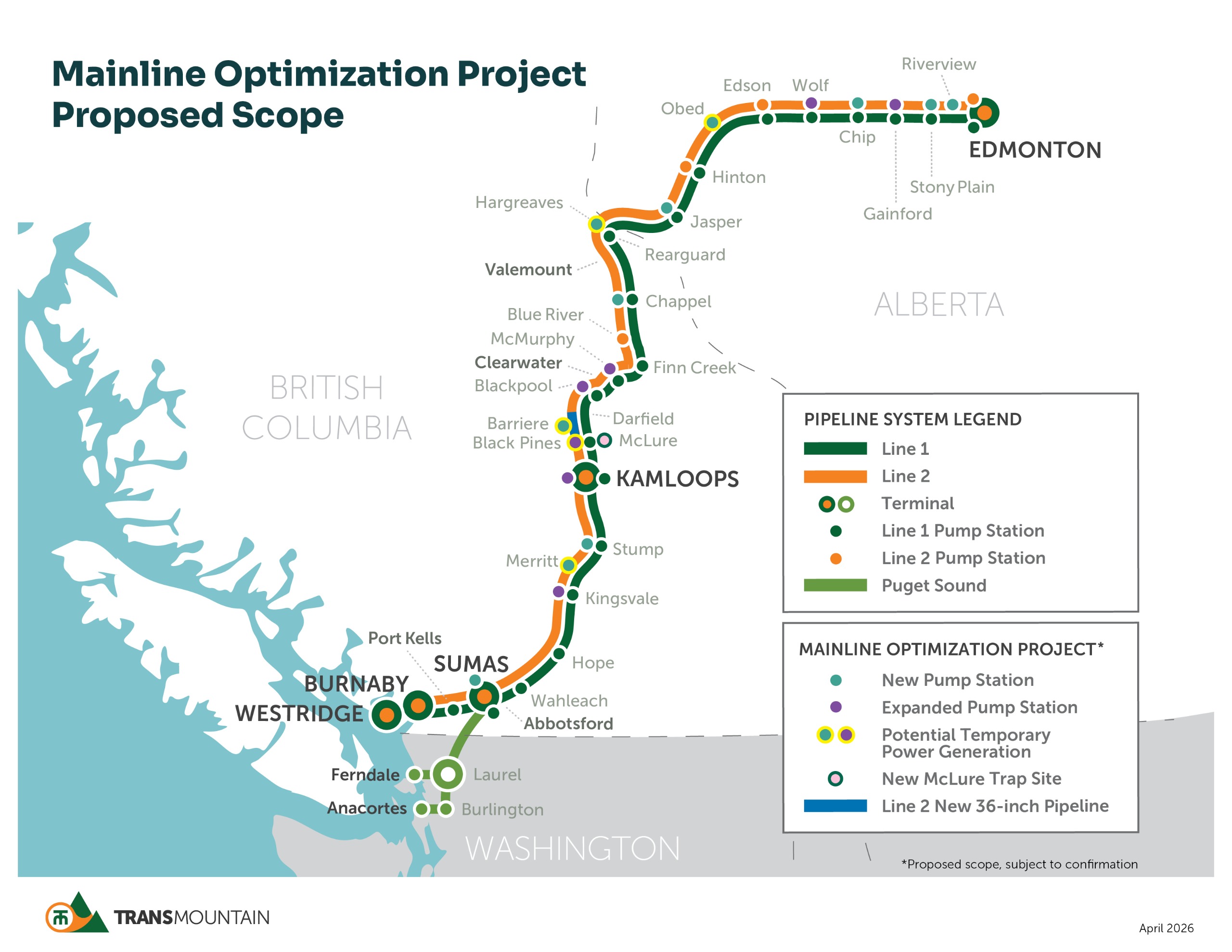
Download a PDF of the map.
Environmental assessments, safety practices and Indigenous and stakeholder engagement will guide all planning and implementation.
Learn More About the Project
Trans Mountain is committed to early, open and respectful engagement with Indigenous Nations.
The pipeline system spans the territories of more than 130 Indigenous groups in Canada and nine Tribal communities in Washington state.
Indigenous Partnership
- Respecting Indigenous rights and interests
- Seeking input well ahead of regulatory filings
- Identifying opportunities for employment, subcontracting and field studies
- Inviting participation in environmental and archaeological studies to guide work and ensure Indigenous inclusion
- Integrating Indigenous knowledge and values into our planning wherever possible
- Supporting post-construction Indigenous monitoring of reclamation and the environment
Trans Mountain’s commitment to reconciliation in action is reflected through ongoing collaboration, inclusion and lasting, respectful relationships with Indigenous Nations.
Learn more about our Indigenous Engagement Program.
Trans Mountain’s Land team engages early with landowners, occupants and interest holders to share information, listen to feedback and meet land access needs.
Consultation with impacted landowners or land rights holders
- Landowners: Properties containing existing or planned infrastructure
- Interest holders: Individuals or organizations with land-related interests
Coordination and compliance
Tracking land requirements and meeting regulatory commitments if the proposed project proceeds.
Commitment to values
Trans Mountain’s core values—Safety, Integrity, Respect and Excellence—guide consistent and ethical engagement with landowners.
Learn more about how we work with Landowners.
Trans Mountain will integrate environmental protection into every stage of planning for the proposed optimization projects, while improving the performance of our existing energy system.
Key environmental measures
- Baseline studies and site-specific mitigation plans reduce impacts on land, water and wildlife
- Indigenous Monitors work alongside Environmental Inspectors to ensure mitigation measures are implemented
- Collaboration with archaeological specialists supports protection of traditional use and heritage sites
- Careful soil handling and erosion control minimize impacts during construction
- Post-construction monitoring continues for at least five years to ensure reclamation success
- Environmental protection continues into operations through a strong asset integrity program focused on spill prevention and rapid response
Our commitment to responsible development supports environmental stewardship, collaboration and long-term sustainability.
Learn more about Trans Mountain's commitment to environmental protection.
Our top priority is to prevent incidents and be ready to respond quickly and effectively.
Preparedness measures
- Responders trained and equipped along the pipeline route
- Spill response uses predictive modelling for rapid containment
- Fire suppression systems and water reservoirs at terminals and remote stations
Exercises and drills
- Annual full-scale deployments
- 20–30 tabletop and field simulations each year
- Unannounced drills to test real-world readiness
Management Program
All-hazards framework covering oil releases, fires, security breaches and natural disasters (floods, earthquakes, avalanches, etc.)
Response plans
- Updated regularly and tailored to local conditions
- Coordinated with regulators
Learn more about emergency management.
Safety is at the core of everything we do. Trans Mountain is committed to protecting the health and safety of our employees, contractors and the public. A strong safety culture guides every stage of planning, construction and operations for our proposed optimization projects.
How we work safely
- Regular updates to safety programs reflecting industry best practices and lessons learned from internal reviews and worker feedback
- Enhanced field safety leadership and ongoing training for employees and contractors
- Rigorous oversight of contractor performance to prevent serious injuries and incidents
- Integration of safety learnings from past expansion and construction projects intonew design and planning phases
We focus on safe construction—ensuring everyone goes home safe every day.
Learn more about pipeline safety.
The Mainline Optimization Project is currently in the planning phase and your perspective is an important part of this process. We invite you to review the project information below to learn more about what is being proposed and to share your input. Your feedback will help inform how the project is developed as we move forward.
Regulatory Review Process
All potential projects are subject to applicable regulatory and permitting requirements. The Canada Energy Regulator (CER) is the primary regulator of the Trans Mountain pipeline system in Canada. Its mandate also includes assessment of economic aspects of pipelines to ensure pipelines and their transportation contracts are fair, efficient, and in the public interest.
Trans Mountain anticipates filing an application for the Project with the CER in Q3 2026.
Contact Us
Have questions or want to learn more about a project, contact us below:
| info@transmountain.com |